
Imagine getting paid less than your coworker for doing the exact same job and putting in the same amount of work. Unfortunately, this remains a reality for many women today.
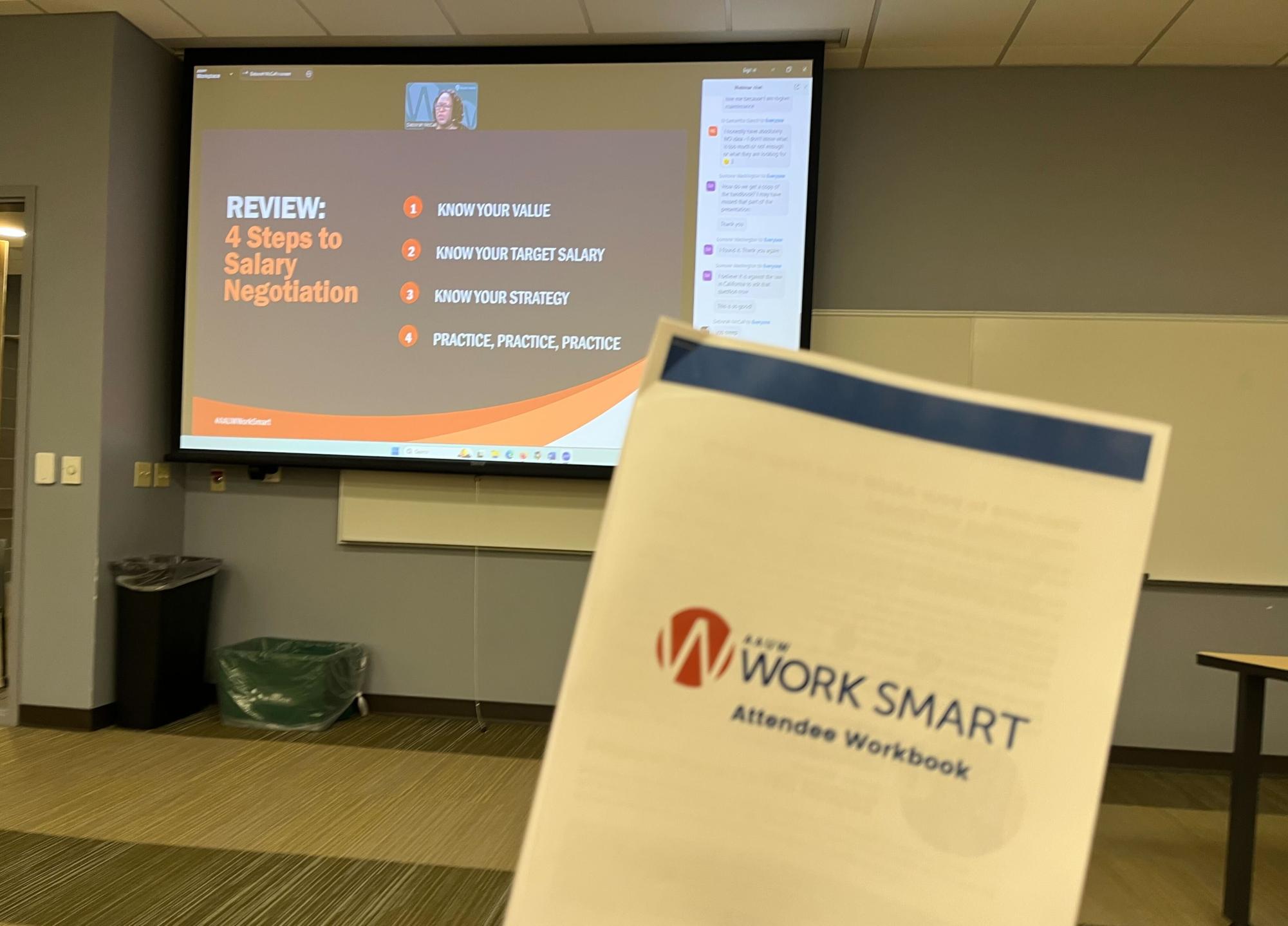
On Wednesday, Nov. 5, the Student Leader Fellowship Program hosted an event in Jamrich Hall to explore this issue further. Students joined a Zoom meeting featuring Deborah McCall, program manager for the American Association of University Women (AAUW), who discussed the gender pay gap and the four-step process of negotiating for better pay.
The AAUW is an organization that seeks equity in higher education and women’s economic empowerment, supporting thousands of women scholars. It was founded in 1881 by women who earned college degrees, defying society’s conventions.
“Women, working full time, on average are paid 81 cents for every dollar earned by a man,” McCall said.
McCall specified that this comparison is based on the earnings of a white, non-Hispanic male. She also notes that women of all races face a disadvantage in pay.
“Women of all ethnicities and races lose $398,060 compared to men of all ethnicities and races …. These lost wages mean women and their families have less money to support themselves, save and invest for the future, pay down debt and spend on goods and services,” McCall said.
Some of the causes of the gender pay gap include women being overrepresented in low-wage jobs rather than high-wage ones and being well represented in undervalued fields such as healthcare, education and public administration. Discrimination also plays a significant role, and race is another important factor in the gender wage gap.
“Some of the causes of racial and gender pay gaps are women are less likely to get promoted,” McCall said. “Fifty-eight black women are promoted to managers for every 100 men, they’re over-represented in agriculture and domestic work jobs that are not protected and then they’re less likely to have access to affordable childcare.”
This led to the importance of pay transparency and salary history, as it is one’s right to receive information about compensation.
“In recent years, local … state [and] federal governments are working to pass legislation that levels the playing field and creates standards around pay transparency …. Why this is important is because it means that you know what the person next to you, or working with you, is actually making [while] doing the same job,” McCall said.
The conversation then shifted to the concept of the double bind, which represents the conflicting demands placed on women regarding behavioral expectations, especially in the workplace.
“Women often have two choices, and this is where the double bind comes in, and that is to be seen as competent or likeable,” McCall said. “Women are sometimes seen as incompetent and may not be given more valuable assignments; you’re seen as likable and everybody likes you—but can you get the job done? But when women step outside of cultural expectations and are assertive or advocate for themselves, they may be seen as unlikeable.”
With this, McCall introduced negotiation and the four steps involved in asking for the pay one deserves. Step one is knowing your value.
“Understand that on the job market, you are your own brand. We talk about … a lot about brands right now, but you’re your own brand,” McCall said. “You sell something that is unique, and that is you. This includes your identity, your combination of work experience, your work ethic, your interests, your goals, your personality and your education.”
You are your best advocate, and to do this you need to document your accomplishments, thinking beyond the task given to you, quantifying your work and knowing that everything counts.
Participants received a template to help articulate their value: “I accomplished [list one accomplishment], using my [list skill used], which benefited my company by: [list results]”.
Negotiation step two is knowing your target salary and benefits. To do this, benchmark your salary through three points: target salary, salary range and walk-away point. Also consider your benefits such as family and medical leave, health insurance, retirement and vacation.
Negotiation step three is knowing your strategy. The best tips McCall gave out were to bring your notes, remain positive and flexible, don’t get personal, anticipate potential reactions and responses and to have the mindset that they picked you so they want to make it work. The important thing is preparing to deflect salary questions until after receiving an offer.
“If you’re asked your expected salary, say something like this: ‘I’d like to see if I am a good fit for [this] before we discuss salary’ or ‘I’d like to learn more about the role’ … or ‘as we move forward in the interview process, I expect that my salary would line up with the market rate for similar positions in this area,’” McCall said. “We’re talking about sample deflection language, so that you can learn more about the job and then you can say what you want to actually make, and then, when they’ve actually made a salary offer, that’s when you start negotiating.”
When asking for a raise or a promotion, make sure you set a time to ask. It is important that you meet with your supervisor and begin the conversation with your pitch. Elements of a strong pitch include thanking your supervisor for meeting with you, showing enthusiasm throughout the meeting, telling them of your accomplishments at the job and finally, asking them for a promotion.
Of course, responses can come back negative such as, “we don’t have the budget,” “nobody earns that much, you would be the highest paid person” or “I can’t give you a raise right now, wait a few months.”
“But here are some sample responses: ‘I absolutely understand our budget, but with my work history, I have demonstrated success in saving our company money. If not now, then do you think we can revisit this in six months?’ …. Or maybe, ‘We could consider looking at some of the benefits in my package just when you look at benefits,’ or, ‘Thank you for your support. I do want to continue and align my values. Can we check again in three to four months?’ Stay positive and just use this language,” McCall said.
The fourth and final step in the negotiation process is practicing. With practice, your negotiation skills will improve. You can practice with others, such as family members, to help you improve your verbal and body language.
Again, the four steps for negotiation are:
- Know your value
- Know your target salary
- Know your strategy
- Practice
Students left more knowledgeable on the gender pay gap and felt more confident in how they could approach future employers for more equal pay.
Interested in becoming an AAUW member or joining the upcoming Webinar Series in spring 2025? Visit the AAUW’s website.