

When the term “health” is mentioned, it is not uncommon to think of one’s physical well-being. It is the most tangible part of ourselves. It is what we perceive with the senses, confirming its existence. Diagnosing a broken leg is much easier than understanding a shattered mind. And yet, a strained emotional state or unstable mentality can affect an individual’s health just as much as a broken bone.
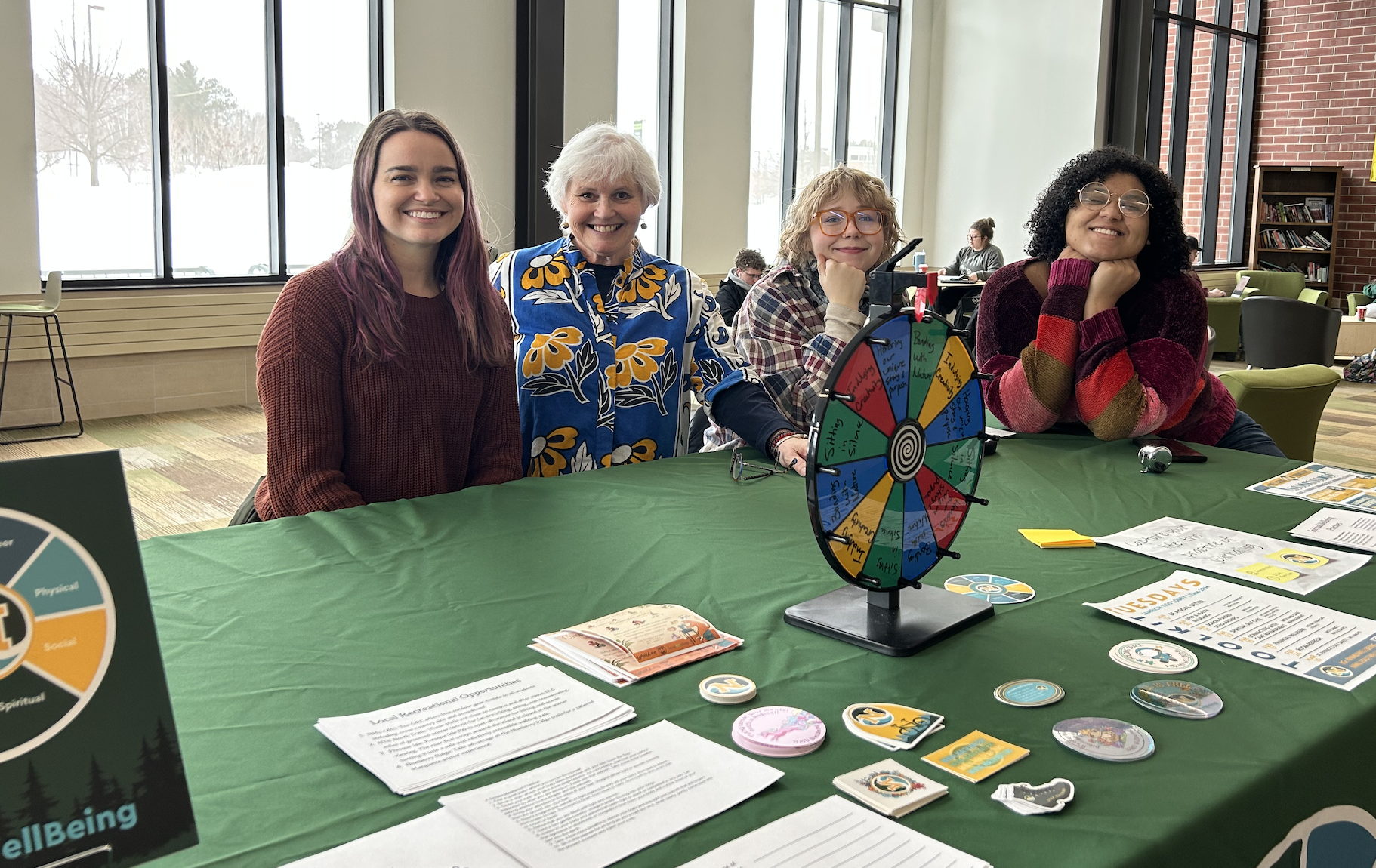
NMU Wellbeing understands that an individual’s health is three-dimensional. It has many sides that constantly change to adapt to its environment. The less observable a part of our health is, the more difficult it is to nurture. On Tuesday, Feb. 3, NMU Wellbeing set up inside Jamrich Hall to understand student perceptions of spiritual health and teach them how to care for it.
Marna Franson, a consultant for spiritual well-being at NMU, brought her expertise to inform students about the many ways they can support their spiritual health. Franson has spent significant time researching how other campuses across the country define spiritual well-being and found something quite interesting.
“What I’ve discovered is that each campus has its own personality, and the way they define spirituality matches that personality,” said Franson. “What I want to know is what students at Northern think spiritual well-being is. Do they have any experience trying to nurture that in themselves? Do they see themselves as having a part of their being that is spiritual?”
In an attempt to understand perceptions of spirituality on campus, NMU Wellbeing set up an interactive wheel that students could spin. The wheel contained numerous ways in which students could improve their spiritual health, such as meditation, sitting in silence, engaging in creativity, journaling, etc.
An essential part of understanding spirituality is nurturing the relationships that surround and define us, which is something Franson wanted everyone who spun the wheel to understand.
“Relationships are messy. They are. I’m going to hurt your feelings, and you’re going to hurt mine,” Franson said. “But if we don’t have relationships, we’re in bad shape. We are not little islands.”
We like to believe that we are each our own island, isolated from those around us, predisposed to being misunderstood, but we are not; we are an archipelago — separate on the surface, but connected beneath the deep waters of perception and identity.
Understanding and caring for your spiritual health is an inherently difficult task due to its intangibility. You can’t see or hear it. It doesn’t come with a taste or smell — it is abstract. There is no lifelong cure, but there are resources, and being able to care for yourself begins with being willing to understand yourself and those around you.
If you were unable to stop by NMU Wellbeing’s stand inside Jamrich Hall, feel free to contact the organization via its website by searching its name on a search engine or by reaching out to a trusted staff member on campus.